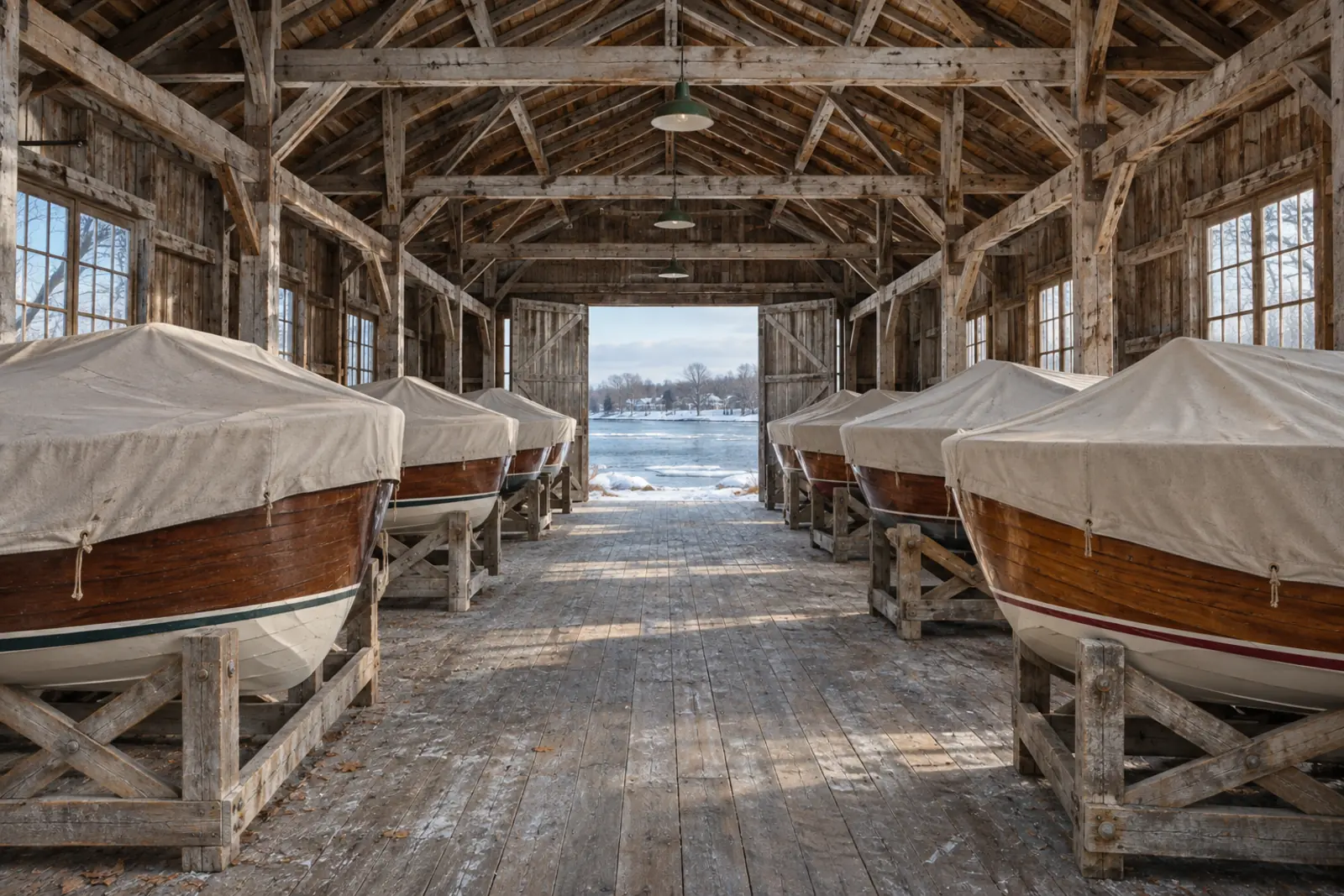
For a classic boat on the St. Clair River, the main winter storage choices are indoor (heated or unheated), outdoor on stands or a cradle under a ventilated cover, and at home on a trailer. Indoor storage protects the finish best and usually costs most; outdoor storage costs less but depends on a cover that keeps snow out and lets moisture escape. In summer the choice is between a boat well, a marina slip, a private dock and a mooring.
Boat winter storage options compared
Most owners lift out before freeze-up, because ice on the river and wind-driven snow can damage a boat left in the water. After that, the real decision is where the boat sits for the cold months:
- Indoor storage protects the finish and keeps snow and ice off the boat. Heated and unheated buildings differ in cost and in how stable the temperature is, which matters for wood and for stored batteries.
- Outdoor storage on stands or a cradle, usually with a fitted cover or shrink wrap, costs less but needs ventilation so that moisture does not collect under the cover.
- Storage at home on a trailer gives full control, but you need to deal with the weight, the cover and the winterizing yourself.
Indoor vs outdoor boat storage: what matters for a classic boat
For a wooden or vintage hull, the main difference is how steady the conditions are. A hull that goes through repeated wet and dry, freeze and thaw cycles moves more than one kept in a building, and old finish, seams and fastenings show it first. Indoor space reduces that stress, but a building that traps damp air is not automatically better than a well-ventilated cover outdoors.
Questions that separate one offer from another:
- Is the building heated, and what temperature does it hold in a hard freeze?
- Is the boat stored on stands or a cradle that supports the keel and structure rather than only the hull planking?
- If stored outdoors, does the cover frame hold the cover off the deck and brightwork, and are there vents at both ends?
- Who is allowed to enter the building or yard, and can you reach the boat during the winter?
- Who is responsible for a fire, a roof collapse under snow load, or a fallen stand, and what does the operator's insurance cover versus yours?
For wooden hulls, see the wood hull maintenance guide for how planking, seams and fastenings respond to drying out and to damp storage.
Summer: boat wells, slips and moorings
A boat well is a covered or open berth cut into the shoreline or a canal, common in waterfront communities along the river. Owners of wooden and vintage boats often like them because the boat sits out of the main current and away from wake. Other options include marina slips, a dock at a private home, and a mooring. Questions worth asking about any of them:
- How exposed is the berth to wake from passing boats and ships, and to current?
- Is the well covered, and does the cover keep sun and rain off the boat while allowing ventilation?
- What happens to depth when lake levels change?
- Is shore power available, and who is responsible for the wiring?
- What are the rules on running engines, maintenance work and overnight stays?
- What insurance is required of the boat owner, and what does the site carry?
A boat that sits in the water all season also needs its underwater metals checked at lift-out; the zinc anodes and corrosion guide explains what to look for.
Getting the boat in and out
Boats are lifted with a travel lift, a hoist or a trailer and ramp. Ask what size and weight the equipment is rated for, how the straps or slings will sit on an older hull, and who is liable for damage during the lift. Wooden hulls need slings placed where the structure can bear them.
Winterizing first
Before storage, the engine and systems need to be prepared: fuel stabilized or drained, the cooling system protected from freezing, oil changed and batteries cared for. The winterizing guide gives the steps, the ethanol fuel guide explains fuel concerns, and the spring commissioning guide covers the return to service. Two related pages go deeper on single systems: cooling system maintenance for freeze protection and draining, and the engine oil change and fluid service guide for fresh oil before layup.
How to compare offers
Ask for the price in writing, what it includes, when payment is due, and how long the offer runs. Check that availability is confirmed, that access to your boat is clear, and what the terms are if the boat needs to be moved. Also ask whether lift-in, lift-out, cover or wrap, and spring launch are included or billed separately, since that often decides which of two similar quotes is cheaper. This site does not rent or sell space and cannot confirm any availability.
Frequently Asked Questions
What are the main ways to store a boat for the winter?
The main ways are indoor storage in a heated or unheated building, outdoor storage on stands or a cradle under a cover or shrink wrap, and storage at home on a trailer. Leaving a boat in the water over winter is generally avoided on the St. Clair River because of ice and snow.
Is indoor or outdoor boat storage better for a classic boat?
Indoor storage usually protects the finish and wood better and keeps snow off the boat, at a higher price. Outdoor storage can work well if the boat is properly supported and the cover is ventilated so moisture does not collect. The condition of the hull and the quality of the building or cover matter more than the label.
What is a boat well?
A boat well is a berth cut into the shoreline or a canal where a boat is kept afloat, sometimes with a roof. It keeps the boat out of the main current and away from much of the wake. It is a summer berth, not winter storage, so the boat is normally lifted out in the fall.
What should I do to a boat before winter storage?
Prepare the engine and systems first: stabilize or drain fuel, protect the cooling system from freezing, change the oil and look after the batteries. The winterizing guide linked above gives the steps in order.
How do I compare boat storage quotes?
Get each quote in writing and compare what is included: lifting, blocking or stands, cover or wrap, access during the winter, insurance responsibilities and spring launch. A lower headline price can leave out items that another quote includes.